
GAIA Fields
"Connecting data to the roots."
Transforming fertigation from static planning into a continuously adaptive control system — bridging the gap between digital agronomy and physical field execution.
The "Black Box" Challenge
Fertilization decisions are still based on static plans, intuition, and partial data. Farmers lack real-time visibility into what each crop actually needs. The result: rising costs, massive waste, and environmental damage.
135%
Cost Increase
Fertilizer costs have surged in the past decade, squeezing farm margins.
50%
Input Waste
Half of applied fertilizer is lost to leaching or runoff before crops absorb it.
$340B
Land Damage
Annual global cost of nutrient leaching — polluting soil, water, and ecosystems.
Our Unique Solution
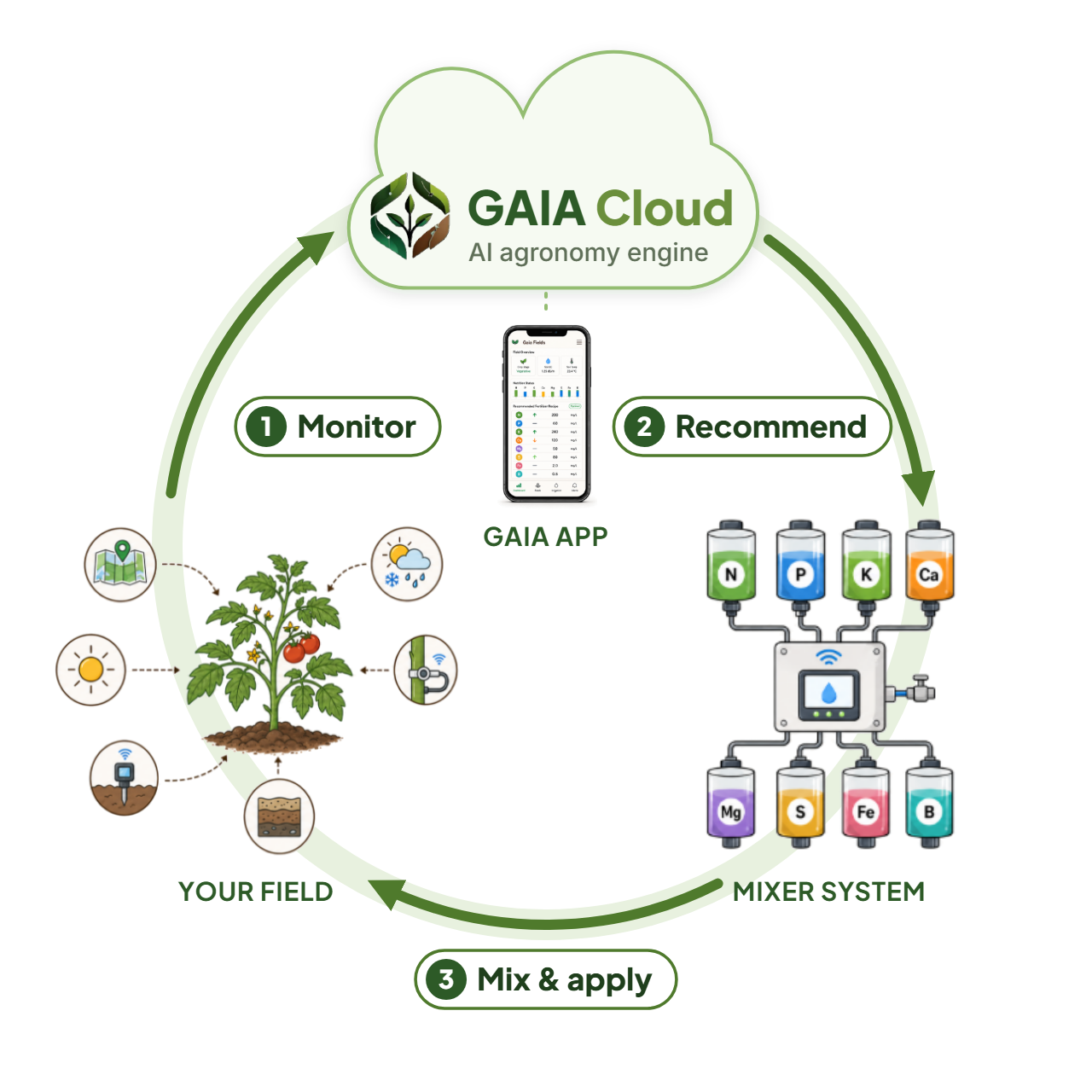
Monitor · Live field data
Soil, weather, and plant sensors report what is happening in the field, alongside its full fertilization history.
Recommend · Per-nutrient precision
Unlike tools that only plan by growth stage, GAIA provides a tailored recommendation for each nutrient, at every fertigation event.
Mix & apply · Automated execution
A multi-tank mixing system executes the recipe with surgical accuracy through the drip line. Then the field is monitored again, closing the loop.
Why now: advances in low-cost sensors, AI-driven agronomy, and precision irrigation make real-time adaptive fertigation possible at scale.
Less Fertilizer
Typically 10–30% reduction in fertilizer use
Higher Yield & Quality
Better crop consistency
Reduced Pollution
Less nutrient runoff
Strategic Roadmap
PHASE 1: POC
Pilot with Hazera. Validate recommendation engine. Collect field feedback.
PHASE 2: MVP & FIELD TESTS
Closed-loop automated dosing. Multi-field testing & iteration.
PHASE 3: SCALE
Commercial deployment & global expansion.
The Founders

Elnatan Golan — CSO
Ph.D in Agriculture & Plant Nutrition

Tuvia Kochavi — CTO
AI & Optimization Systems Engineer